
The Off-Grid Kitchen: Romance vs. Reality (a new series)

Images of beautiful and functional rustic kitchens, fresh baked breads being taken from a woodstove, bushels of potatoes stored away in the root cellar, and family meals eaten around a large farm table were all on my mind when I pondered our move off-grid and how that would change my time in the kitchen.

We’ve lived without electricity or running water as most people know it now for ten months. A lot of progress has been made when I look back on it, but we are nowhere near the rustic functional off-grid kitchen that some might consider ideal.
When we made our move I knew that we had two options:

  1. Spend a substantial amount of money upfront to construct a home with a large, functional kitchen.
  2. Slowly build that home and kitchen over time after other priorities like fencing, water, and food production are taken care of.

Since our goal is to build our homestead debt-free we went with option number two. And while my kitchen may not look like the dream kitchens of magazines, it has  suited its purpose well enough thus far.
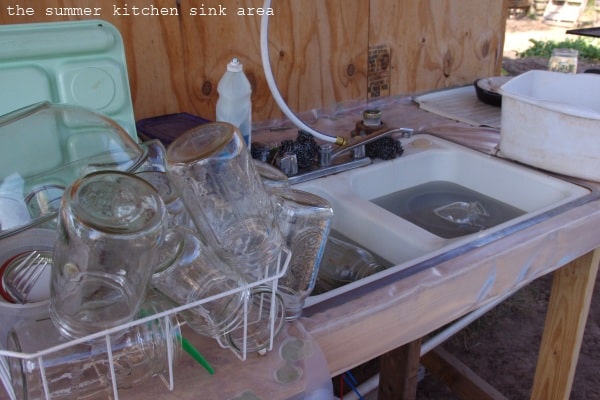
I remember the day we started using an actual, real sink… that drains and holds water. That was almost as exciting as when a solar-powered water pump began bringing water from our rainwater catchment tank right into our kitchen. If looked at in the proper context, our kitchen is luxurious.

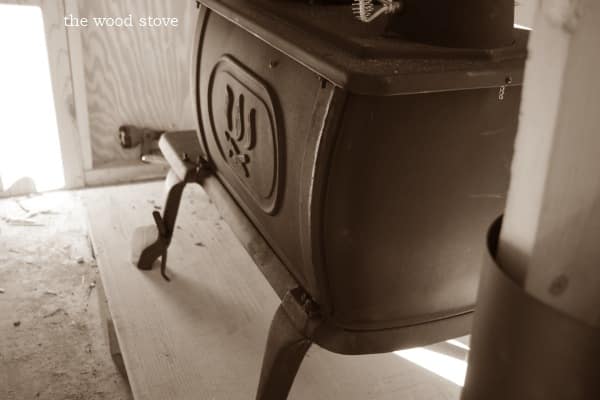
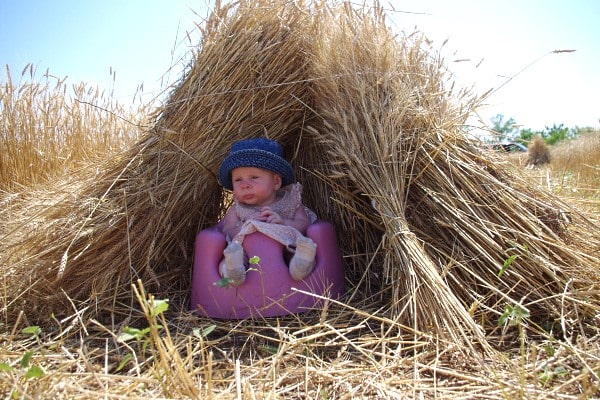
There have been sweet potatoes thrown right into our wood stove after breakfast and cooked until tender perfection as the base of a lunch meal. Bread has been baked from wheat we harvested, threshed, and ground by hand.
But there have also been too many burnt-bottomed casseroles to count; dealing with ants, flies, and the elements; and learning to take the sustainable foodways I learned on-grid and continue them without the conveniences I once had.

Navigating the off-grid kitchen is something I have enjoyed and struggled with over the past ten months. Having neighbors and friends who also live off-grid has come to show me that no two kitchen set ups will look alike, even if you’re striving for similar ends.

The kitchen is absolutely the most important feature of the off-grid home we continue to build. Because we wish to grow our own food; the kitchen becomes the office, workshop, and center of nourishment in our home. In creating floor plans and setting priorities, the kitchen is number one behind a root cellar and basic shelter.
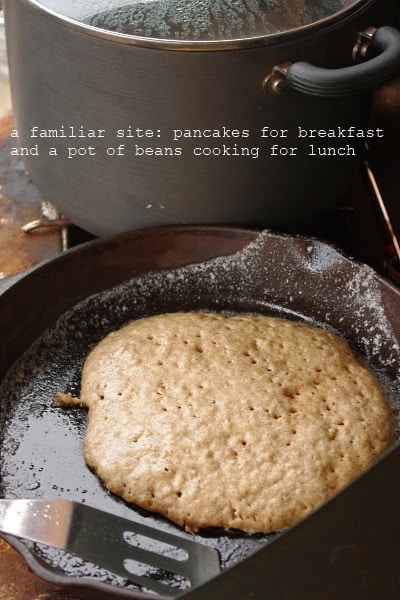
We are attempting to develop sustainable ways to cook food, keep it cool, process it, store it during extreme heat and cold, and keep everything sanitary with an off-grid water system based on rainwater catchment. And we are trying to do it without debt, electricity, or unsustainable fuels.

In this series I hope to share basic methods of keeping an off-grid kitchen running, how we do the basics that are often taken for granted like cooking and cooling, and how it can be done if we just take a step back and keep it simple.

Please join me as we learn our way through building a sustainable, off-grid kitchen.

16 Responses to The Off-Grid Kitchen: Romance vs. Reality (a new series)

  1. I love Shannon’s blog and am looking forward to this series! Hopefully I’ll pick up lots of good information for my own off-grid kitchen, which is still in the planning stages.

  2. I know there is a big difference between the romance of living off the grid and the reality. We are so used to our conveniences most of us are going a little nutty if the power goes out for a day or two, and that includes me. I used to visit Sturbridge Village in Massachusetts and wish we could live like that. The closest we got was growing vegetable and herb gardens, canning some of the produce, and me sewing a sampler on linen. I’m actually a little afraid of how people will behave in the event many of us are cut off the grid suddenly. We will be afraid, won’t know how to get food or water, and frightened people are capable of doing terrible things. I like the idea of getting off the grid because we’re so dependent on it. We’re hooked on the ease of our lives. We live in the north where the winters can be harsh and the summers hot, yet people managed off the grid for many years before us. We’re the first generation to be so hooked on technology that we’ve forgotten how to sew a button on or start a fire, or manage a small garden but man, we can text faster than lightning and find our way around a GPS unit like nobody’s business!. Knowledge is power though, and with determination and some help, we can break the chains of technology. And we have the luxury of a little time and the best information available, right at our fingertips. Better to learn this in a non crisis situation and be prepared than trying to figure it out with the scared masses when Home Depot has been looted and all the gas is gone anyway. Thanks for writing this blog… it’s a great inspiration for the rest of us!

    • I am very grateful for people like you passing on their experience, (good and bad). I would like to start setting up an off-grid way of life, but don’t know where to start. We live in a manufactured home on 2 !/2 acres in an area where it does not rain for 4-5 months during the summer/ late spring and early fall. Therefore the rain water deal wouldn’t work. Also where and how can we start? Financially we still owe a large amount of money on the house.
      Also, I am addicted to hot baths, how do you all do personal hygiene and laundry? I know what a pain it is to do laundry by hand with a washboard and scrub brush. I had to do this as a child in Germany in the 1960s, but as a mother of 9 children I dread the idea of having to do laundry this way. I know these are a lot of questions, but any ideas and info/help would be very much apriciated.

      • Hey Martina, we have a fantastic outside/summer kitchen with a big wood-fired oven. I would suggest that you look into acquiring a big water tank to collect the rain water when it does fall, and creating a space outside where you can start slowly with a patio, we found a book in the library about making wood-fired ovens and there is lots of info on the net to give you ideas about doing it on the cheap. We have ‘up and down’ washes as we don’t have a proper bathroom – we live in a house bus and a small shed with our 4 children who are teenagers. Our kitchen is just a big roof with a tarp for walls at the moment but we are looking into what we can use to make the walls more permanent.

  3. I’m so eager to learn more about this. I think our life of conveniences will be disappearing soon and I want to learn as much as I can to help my family and others get through it. Thanks everso!

  4. We are attempting to do more “off grid” living, but it is hard. I admire you for doing this and sharing both the good and the bad. You aren’t candy coating the rough stuff and we need to hear this. thank you for your honesty and transparency. I look forward to reading more. :-)

  5. Being on the other end of a nice long life, I have had time to collect a lot of things that will make our lives a little easier when there is a big crash (and I DO believe there will be one). Our family camped out for years on all our vacations so we have camp stoves, coolers, sleeping bags, etc., etc. I was the only person in our neighborhood fixing bacon, eggs and hot coffee for my husband while he was out removing several feet of snow from our driveway one winter. No electricity did not slow us down. I NEVER get rid of old long underwear, sweatshirts, etc that might come in handy for someone during an unheated blizzard. Get on the “net” and start looking at survival sites that will give you a lot of ideas that you should be preparing for now. There are even a few government sites that will tell you things that all households should have in case of an emergency. And keep reading Shannon’s blogs. She may be young, but she is one smart inventive lady and I wish blessings on her and her family.

  6. I was raised on a farm in northern alberta without electricity… here are a few things you can do.. my dad had an icehouse.. he would cut blocks of ice off of our dugout in winter.. an store them in a root cellar packed with clean straw for the summer months. Canned chickens are one of the really great convenience foods.. we would spend a day butchering and canning chickens… pressure cooker is essential for that.. my mom also canned moose meat. A brine pot.. for butchered pork will increase the lifespan of your pork by weeks…

    • Keith that sounds like the way I grew up in NE Saskatchewan.We had no electricity that in turn meant no conveniences at all. Not only did we live on canned wild meat,chicken,pork, vegetables, fruit and eggs in water glass over the winter months, but the cellar was full of root vegetables that lasted one season to the next. Everything was baked or cooked on the wood cook stove. Believe me that was no fun in canning season!Wild berries are almost a thing of the past sadly but we had lots of them canned as well as peaches,pears, and plums from the store in town.My dad came to Canada as a child with his parents so they were among the many who settled the farm land in our area close to Nipawin SK.I still live out there every spring to fall, but come to town for school months for my grandson. My oldest son lives the way I grew up, no modern conveniences except his snappy new vehicle and a generator.It’s not for everyone, but I think some folks see it as romance with the land…not sure of that!

      • Vicky – Thanks so much for your story! It’s really interesting to hear everyone’s experiences and points of view.

    • Keith – I would love to have an ice house, but here in central Texas I’m not sure how possible that is. We are actually planning to butcher some of our roosters here soon. We’re debating just knocking one off per week for a while or actually doing one big butcher/can session.

      Could you tell me more about the brine pot for pork?

  7. I really wish you would do a videos. For example: Day 17- “Today we are baking bread, here is the recipe on planttoeat, put the dough in the pan, this is how we figured out how the oven is right. Whoops, we burned this and here’s why. I would follow you putting meals on the wood burning stoves and ovens and what you cooked on a webshow. See Lizzie Bennet Dairies. See Wartime Farms on homesteadsurvival.com March 7th for inspiration.
    (Prefer if a recipe has steps such as how to make the bread to read it in your website- planttoeat),

Leave a Reply

Your email address will not be published. Required fields are marked *

*

You may use these HTML tags and attributes: <a href="" title=""> <abbr title=""> <acronym title=""> <b> <blockquote cite=""> <cite> <code> <del datetime=""> <em> <i> <q cite=""> <strike> <strong>