
Making Kombucha

Kombucha is one of those things that just sounds like hippy food. Like “Yeah, I had sprouted tofu for lunch with a big glass of kombucha.” Or, “I spent the morning churning my raw cream into butter and need a kombucha.”

Maybe neither of the above are things you’d say, but you’ve probably heard of kombucha. It’s making a resurgence in health food stores and for good reason.

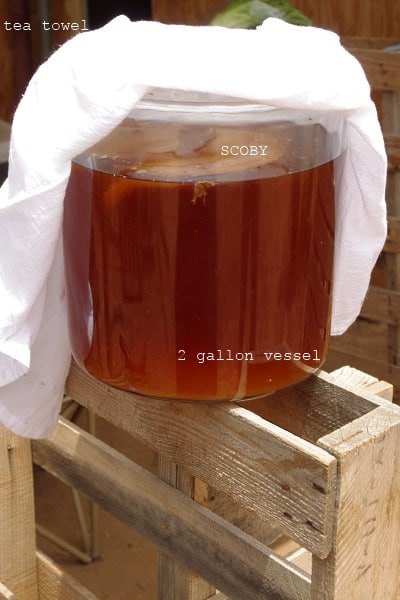
Kombucha is a fermented tea that is an age-old digestive tonic. This beverage is made by making a simple sweet tea – usually organic black tea and white sugar, but there are other options – and adding a kombucha starter, called a SCOBY, to the tea.

SCOBY may seem like a random term for the culture, but it is an acronym for what the culture is – a symbiotic culture of bacteria and yeast. These bacteria and yeast feed on the sugar in the tea to create all sorts of beneficial acids, probiotics, and vitamins.

Of particular note is the acid called glucoronic acid that is produced by the kombucha making process. This acid is incredibly helpful in detoxing the liver which is part of the reason kombucha is known not only as a digestive aid, but also a powerful detoxifier.

If you find a bottle of this stuff at your local health food store, though, you’ll probably pay at least $3. So we make it at home in large batches for around $.20.
To make a gallon of Kombucha

  • 3 1/2 quarts of water
  • 1 cup sugar
  • 8 tea bags (or equivalent of loose leaf)
  • 1 kombucha SCOBY (see sources)
  1. Boil water and add to gallon-sized glass jar along with sugar and tea.
  2. Allow to steep for at least 20 minutes or until the tea has cooled. Be sure to stir the sugar into the tea as it steeps. Remove the tea or tea bags once cooled to room temperature.
  3. Carefully add the SCOBY and stir with a plastic or wooden utensil. Cover with a breathable material like a clean towel or coffee filter. Be sure to fasten with a rubber band or tie in order to keep fruit lies out.
  4. Place in a dark place that will have a fairly warm (65+ degrees) and consistent temperature. Allow to culture for 5-24 days, depending on temperature. Check after five days by tasting. It is done culturing when the SCOBY has produced a 2nd “baby” SCOBY and it tastes slightly tangy and less sweet than it was. How sweet it tastes is directly related to how long it ferments so if you’d like yours more tangy than sweet simply allow it to ferment longer.
  5. Drink and enjoy!

18 Responses to Making Kombucha

  1. Pingback: How I Quit Drinking Soda for the Sake of my Health… and Two Cheap and Healthy Lacto-Fermented Beverage Alternatives — Saving Naturally

    • I don’t think you can make it without the sugar, Linda. The bacteria and yeast need to feed on something and stevia wouldn’t work. Honey would probably work and agave nectar might work.

      • Honey has natural antibacterial properties, so it shouldn’t be used with kombucha or kefir. :-( Bummer, I think it would taste wonderful.

      • Honey doesn’t work… Tried it. Sugar is what is feeding your culture. You can choose a good quality sugar if it worries you but without the sugar your Kombucha is going to slowly suffer and die. The good news is that the end product especially the longer you leave it has much less sugar then you are putting in it. It has been converted into CO2 and alcohol along with other things.

    • Hi Linda,

      We’re a no white sugar family as well so that was my initial concern. Here’s the thing about kombucha: the SCOBY actually uses sugar as food which is how it creates things like B vitamins, probiotics, etc.

      So, quite a bit of the sugar is eaten up in the process and if you don’t mind a pretty tart kombucha, it is all but eliminated with a longer fermentation time.

      Stevia would not work because it does not contain carbohydrates and your SCOBY would die from lack of food.

      You can make kombucha with honey and their is a great recipe for it in the book “The Complete Idiot’s Guide to Fermenting Food” by Wardeh Harmon.

    • Well, kombucha does contain yeasts. There is some misinformation out there about all yeasts being bad for you. I don’t believe this to be the case, but it might be in some specific instances. You might try it and see if you have a reaction before committing to making bit batches of it at home.

  2. Honestly, I’ve always wanted to do this (I can’t stand paying so much for it at the grocery store), but am scared. I’ve heard several horror stories about people dying when they make their own kombucha at home becuase of the SCOBY growing too many harmful bacterias and then hurting the person who drinks it. How do you guys make sure that it is all good, helpful and healthy bacteria that is growing?
    megnewsom (at) gmail (dot) com- would love to hear!!

    • @Meghan…My concerns exactly. I have a Russian friend that was drinking this at her house, but her limited English made it hard for her to answer my questions, other then that it’s very healthy and she drinks a cup full every day.

      Can someone please explain exactly what the benefits are? How much is a good daily regimen? And how do you keep the unhealthy stuff out?

      TY…trish in Spokane, Wa

    • If you follow the directions, wash your hands thoroughly before handling the SCOBY (and don’t use antibacterial soap!), and practice cleanliness throughout the process, you’ll be fine. The horror stories are usually due to having drunk WAY too much kombucha and not because of any poisonous mold growth. I’ve been brewing kombucha for just about 2 years now, and if you get a moldy batch or if your SCOBY dies, you know. Read Sandor Ellix Katz’s “The Art of Fermentation” for more of the science behind it, but if you just brew it according to directions, the bacteria that grows are the good ones.

      As a general note, keep in mind that all fermented foods should be consumed bearing in mind that increasing quantity isn’t always “better.”

      As another general note, this original article says kombucha contains glucoronic acid, and the above mentioned book by Sandor Katz debunks this. It contains gluconic acid, which isn’t as much of a liver detoxifier though it has a similar name.

      The health benefits of drinking kombucha are a promotion of overall health by repopulating your gut flora.

    • Hi Meghan,

      I’ve heard crazy rumors like that too but let me tell you that those scenarios are so unlikely as to be laughable. If made properly, kombucha protects itself from harmful bacteria. You can have mold develop on your kombucha but that is usually a case of not using enough kombucha starter to create the acidic environment necessary for the kombucha to fold beneficial yeasts instead of mold.

      The signs that it is bad will include:
      visible mold
      off smells
      off flavors

      Again, it is highly unlikely that your kombucha will kill you or even make you sick so long as you follow the proper guidelines and know what to look for.

  3. After you make the tea to your taste…how do you stop it from fermenting any further? Do you put it in the fridge? tHANKS

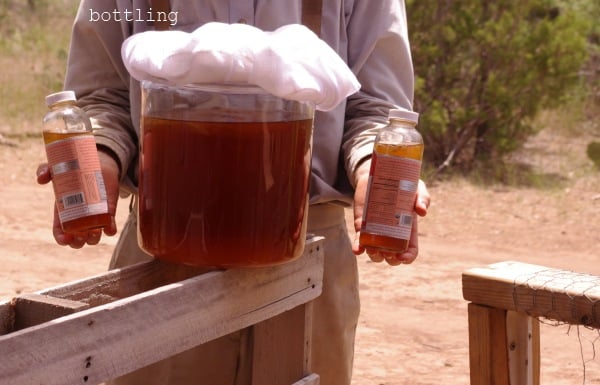
    • I put mine in repurposed pressure release bottles and keep it in the fridge to slow down fermentation. It will still keep going until it runs out of food but I date and rotate bottles. I forgot one bottle in the back of the fridge for 2 months, it made quiet the loud pop and overflowed due to the carbonation, was incredibly sour, but danced off the tongue.

  4. how do you then flavour the kombucha say you want to add ginger do you juice the ginger and add to the finished drink?? my kids like the ginger flavour….!!

  5. I’ve no idea why, but my kombucha tastes like apples, which is nothing like any commercial kombucha I’ve had. Has anyone else had apple-y kombucha?

    • Julia – Does it taste like apple cider vinegar to you? Sometimes I drink a teaspoon or so of apple cider vinegar in water and the acetic acid is reminiscent of kombucha.

Leave a Reply

Your email address will not be published. Required fields are marked *

*

You may use these HTML tags and attributes: <a href="" title=""> <abbr title=""> <acronym title=""> <b> <blockquote cite=""> <cite> <code> <del datetime=""> <em> <i> <q cite=""> <strike> <strong>